

The Short Version
A Google Ads Audit in 2026 should prioritize conversion signal quality and intent mapping. To stop budget leakage, businesses must audit their Search Terms Report for irrelevant queries, ensure Negative Keyword lists are updated weekly, and verify that Landing Page Load Speeds are under 3 seconds to protect Quality Scores and lower Cost-Per-Click (CPC).
The “Smart Bidding” Trap
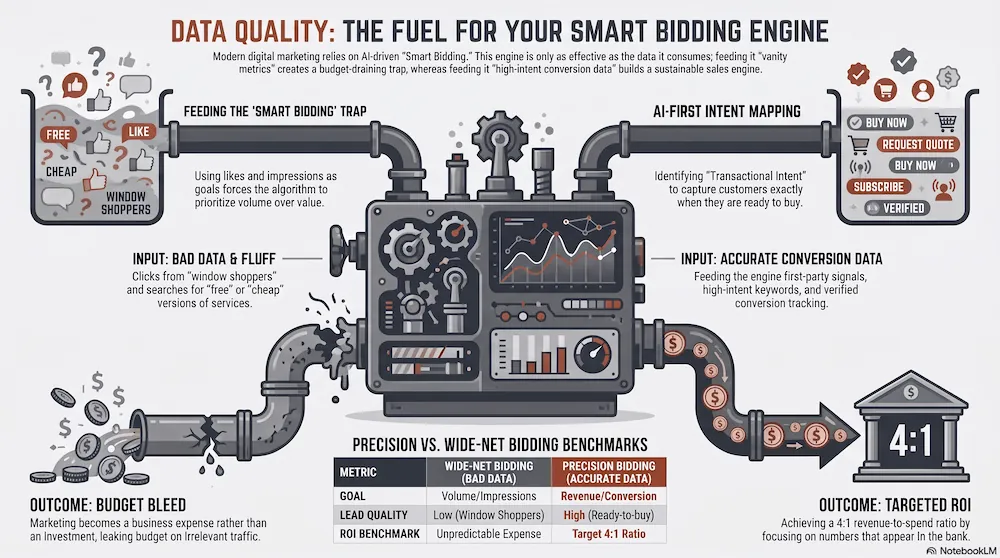
In 2026, Google’s AI is more powerful than ever, but it is a “hungry” algorithm. If you do not feed it the right data, it will aggressively spend your budget on volume rather than value.
At Irrupt Marketing, we see this constantly: businesses rely blindly on automated “Smart Bidding,” assuming the platform knows best. However, Smart Bidding only works if your conversion tracking is 100% accurate. If it is not, you are essentially paying Google to find you more of the wrong people. True partnership means we look past the automation to ensure every cent spent aligns directly with your bottom line. We prioritize precision and shared success over simply letting an algorithm run wild./
Step 1: The Search Terms Reality Check
The foundation of any audit begins with intent. Go to your Search Terms Report. This shows you exactly what users typed into Google before clicking your ad.
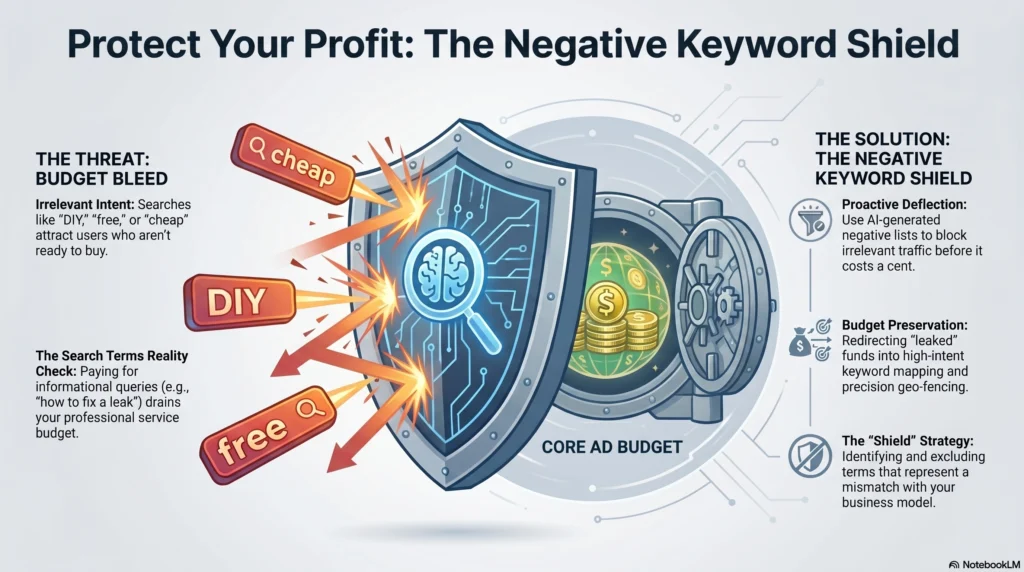
Are you paying for “free” or “cheap” versions of your service? Are people merely looking for information, or are they ready to buy? For example, if you are a high-end plumber in Johannesburg and you are paying for clicks on “how to fix a leak,” you are bleeding budget on window shoppers. We need to ensure you are only visible to clients actively seeking to hire a professional.
Irrupt’s Pro-Tip: Do not confuse clicks with intent. Review your Search Terms Report weekly. If a term doesn’t indicate a clear desire to purchase or inquire, eliminate it. Together, we can refine this to ensure you only pay for high-value prospects.
Step 2: Intent Mismatch & Negative Keywords
Negative keywords act as the “shield” of your campaign. They tell Google exactly who not to show your ads to.
In 2026, we deploy AI-generated Negative Lists to proactively block irrelevant traffic before it costs you a cent. By building robust negative keyword lists, we eliminate budget bleed and guarantee your ad spend is dedicated exclusively to users searching for your specific solutions.
Step 3: Quality Score vs. Landing Page UX
Google rewards relevance. If your ad promotes “Luxury Web Design” but directs users to a generic homepage, your Quality Score drops, and your CPC (Cost-Per-Click) rises.
The Jargon Buster: Quality Score Your Quality Score is essentially Google’s rating of the quality and relevance of both your keywords and PPC ads. A higher score means lower costs and better ad positions.
We fix this by focusing on “The Golden Thread”—ensuring the ad and the landing page tell the exact same story. Furthermore, because we build web experiences as 24/7 sales engines, we ensure your page load speeds are lightning-fast. A landing page that loads in under 3 seconds protects your Quality Score, keeps users engaged, and maximizes your conversion rate.
Step 4: Location & Schedule Precision
Precision targeting is about being in the right place at the exact right time. Ask yourself: Are you showing ads at 3 AM when nobody is in the office to answer the phone? Are you paying to target the entirety of Gauteng when your service area is strictly Sandton?
By applying strict Geo-fencing and tightening your Ad Scheduling, we can instantly save 15-20% of your budget. We ensure your ads only run when and where your actual customers are looking.
Step 5: Conversion Tracking Integrity
If you cannot see which keyword led to a phone call, you cannot optimize your strategy. It is that simple.
To future-proof your campaigns, we implement Enhanced Conversions. This ensures that even in a cookieless digital landscape, your return on investment is demonstrable and fully accountable. We build our partnership on transparency; you will always know exactly where your leads are coming from.
Summarise This Post With AI
We believe in giving you the tools to take immediate action. Use this prompt with a large language model (like ChatGPT, Claude, or Gemini) to get a tailored takeaway:
The Irrupt Summary Prompt:
“I am running Google Ads for my [Insert Business Type]. Summarise this audit guide and tell me which of these 5 steps is most critical for a business with a monthly budget of [Insert Budget].”
Google Ads Audit FAQ
How often should I audit my Google Ads?
Perform a deep-dive, strategic audit quarterly, and review your “Search Terms” report weekly to catch any emerging budget leaks.
Why is my Cost-Per-Click (CPC) so high?
High competition and a low Quality Score often cause high CPCs. Improving your landing page relevance and user experience is the fastest way to lower your CPC.
Should I use Broad Match keywords?
Use Broad Match keywords only if you have a massive “Negative Keyword” list and exceptionally strong conversion tracking data. For boutique businesses, relying on Phrase and Exact Match is usually a much safer, higher-ROI strategy.
: Can AI manage my ads for me?
AI is incredible at optimizing bidding and handling technical tasks at scale, but it cannot understand your unique business goals or profit margins. A human-led strategy remains the primary driver of actual ROI.
Editor’s Note:
At Irrupt Marketing, we use AI tools to help brainstorm content and design infographics. Every post is thoroughly fact-checked, edited, and verified by human marketing experts to ensure high quality.